Game Design for semiconductor industry:
Chip quest
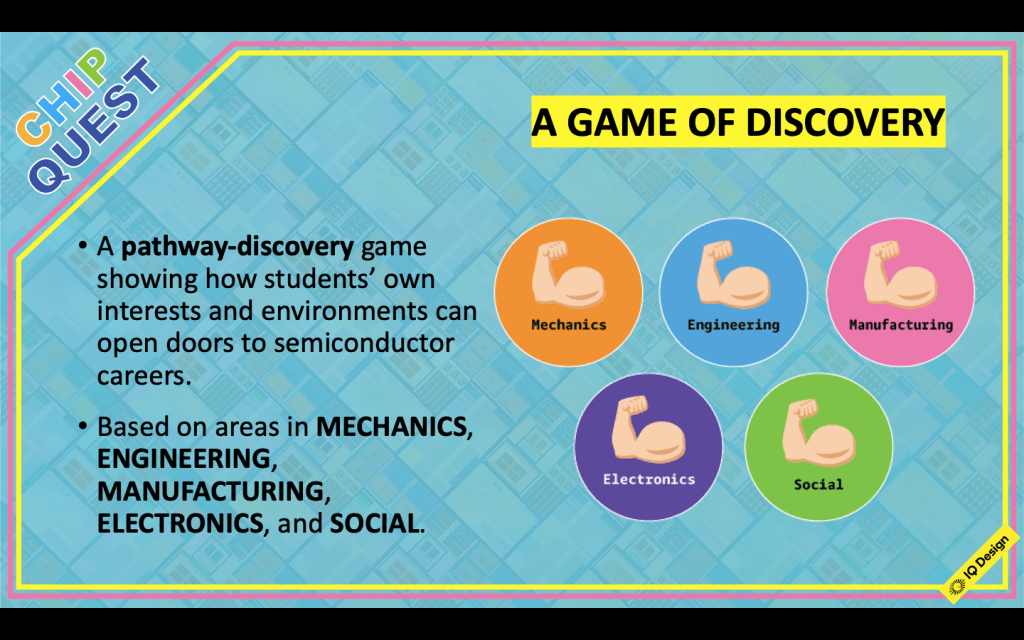
ChipQuest is a career-discovery board game co-designed with IQ-Design lab colleagues to demystify the semiconductor ecosystem for high school students, teachers, and counselors. Built through extensive industry research and educator partnerships, the game translates complex fabrication and workforce pathways into an accessible, hands-on learning experience now used across North Texas.



Critical Web-Design interaction
Prana-Breath: A Critical Web Interaction on the Politics of Air and Everyday Choice
Prana-Breath is an interactive web-based experience designed to provoke critical reflection on the personal and political dimensions of air and breath in a post-pandemic world. Set in urban indoor and outdoor environments, the project invites participants to engage with evolving relationships to air quality through the lens of eight distinct personas—from the indifferent Sleeper to the visionary Guardian.
Players move through narrative choices inspired by everyday scenarios—such as waking to stale indoor air or encountering disinformation online—that mirror real-world tensions around environmental health, civic action, and technological response. Each decision shapes the player’s alignment with a specific persona, revealing how individual behaviors and collective attitudes intersect in the politics of breath.
This speculative design work combines game mechanics with reflective storytelling to reposition breath as not only a physiological act but a sociotechnical concern—raising critical questions about governance, care, and resilience in the face of shared vulnerability. I invite you to experience the interaction here: Prana-Breath


EMbodied interfaces & reflective design
Mindful Motion: An AI- Inspired Exploration of Yoga in Everydayness
Yoga is much more than the physical practice. At its core is practice of self-reflection and self-discovery. This work is inspired from body postures that communicate our emotions and mental state. The everydayness of yoga is about becoming self-aware with breath, body, mind and soul. Often bodily postures change when seen in a reflection. This interaction is designed to provoke the visitor of that very reflection in a nuanced way using technology to reflect upon inner feelings with the body posture as a mirror.
EDUCATION
STE(A)M-Ed in district libraries: SEEKS TO CREATE OPPORTUNITIES FOR BOTH LIBRARIANS AND SCHOOL TEACHERS TO WORK COLLABORATIVELY IN CREATING CONDITIONS FOR ‘CRITICAL PEDAGOGY’ AND ‘PLAY’
Under the aegis of the Rural Development and Panchayat Raj Department and as an extension of their Oduva Belaku programme during the pandemic to support continued learning in community spaces in response to the stark digital divide, STE(A)M-Ed sought to re-energise Gram Panchayat libraries by introducing a science, technology, engineering, arts and mathematics curriculum for students of all age groups. This programme seeks to create an alternative space for experiential, play-based learning, that gives both the librarians and teachers a chance to conceptualise the idea of learning in a new way for their students.
IBM STEM FOR GIRLS: seeks to inspire the next generation of girls to embrace STEM (Science. technology. engineering. math)
A STEM mindset has its roots in scientific temperament, marked by a nuanced understanding of the subjects, and their application in everyday life. It’s a mindset that drives students to become change makers, steering social development. Cultivating a STEM mindset is about becoming critical thinkers, problem solvers, experimenting, and challenging the status quo using technology as a tool. It’s important that a STEM mindset is instilled among students, especially girls, at a very early stage in the education system to dispel biases. There’s a strong need for cultivating STEM skills and mindset among girls to ensure gender parity. I have been leading Yuva Chintana Foundation’s efforts as an implementing partner for IBM and Quest Alliance to reach nearly 10k govt secondary school children across 11 districts in Karnataka under this initiative.
PROJECT 101: SEEKS TO CREATE OPPORTUNITIES FOR STUDENTS TO SOLVE PROBLEMS MORE THAN MANY WAYS
Problem solving is one of the most important activities that we as humans face each and every day. It is our ability to solve problems in unique and creative ways that helps to set us apart from other forms of life that inhabit this planet. In order to solve problems, we must first have an understanding of what constitutes a problem and the many possible ways one could solve it. This is a project to encourage middle schoolers in urban poor settings to build an aptitude for problem solving in their immediate surroundings and in turn become self-aware of their future inclinations.
ARTIFICIAL INTELLIGENCE (AI) for schools: created a pool of talented high-schoolers as ai problem solvers
This five-month project sought to use a fresh approach to bridging the digital divide for students who came from underprivileged sections of society by teaching them about technology, specifically about artificial intelligence and coding through games and other interesting applications that were easily downloaded on smartphones. By the end of the project students presented concrete AI solutions for some of the problems that we face as a society. These presentations were a small snapshot of what our younger generations are thinking about and what our future world could look like. With the support of Intel, we found a way to give these students a voice. Not only did we give them an opportunity to share their opinions, we gave them the skills with which to frame their concerns, use research to arrive at conclusions, build an argument for the problem they identified backed up by data and organise all their findings to make a compelling pitch for the solutions they have arrived.
Halasuru traverses: trained middle schoolers to create a digitally fabricated leather puppet show
As a beneficiary of the Herman Miller grant through Maraa Media Arts Collective in 2016-17 executed ‘Halasuru Traverses’ project enabling community children in Halasuru to re-trace the history of their neighbourhood by exploring traditional form of puppet making and upskilling them to create digitally fabricated leather puppets for a final public showcase.
talking devices: A special exhibition curated to trace the development of communication devices (phonograph- gramophone- analog to digital recorders- telephone- radio)
As a joint fellow of Archival and Museum Fellowship from Tata Trusts through India Foundation for the Arts, I co-curated a special exhibition called ‘Talking Devices’ from the collections of the Visvesvaraya Industrial and Technological Museum (VITM) in Bangalore. Owing to the museum’s rich collection and loaned objects from the public the exhibition constituted the history and technological development of early communication devices. The exhibition presented the design history and the cross-cultural perspectives connected to the design, production use and disposal of the curated objects. With workshops and curated talks I invited the public to engage in discussions on the role and future of contemporary gadgets.

kali-kalisu: an arts education teacher initiative
Kali-Kalisu was an arts-based teacher training programme for government school teachers across the length and breadth of Karnataka. The Kannada words “Kali-Kalisu” translate as “learn and teach,” and serve to remind teachers that education is a lifelong quest, that learning and teaching happen side by side, and that the joy of learning stems from the joy of teaching.
Kali-Kalisu was a joint project of India Foundation for the Arts and Goethe-Institut/Max Mueller Bhavan, Bangalore between 2009-2013. It addressed issues of the arts, culture, education and development through the pivotal figure of the school teacher. Everyone who has had the benefit of an education remembers at least one teacher who made an inspirational difference, and Kali-Kalisu was committed to creating conditions from which more such teachers emerge. Through the project, a large number of teachers from primary and high school levels gained exposure to the best of the arts by facilitators who are artists and educators. Music, dance, theatre, visual arts, and puppetry were at the core of the programme.
Kali-Kalisu was a multidimensional project, and each of its frames led to specific questions and challenges. Within the institutional framework of IFA, the project charted a trajectory where it originated as a series of teacher training workshops and brought into its ambit other recommendations, such as capacitating resource centres, sparking off teacher and artist grants, and discourse development in the field.
numbernagar: A math activity centre
NumberNagar was a unique intervention towards integrated and contextualised mathematics learning within the primary and middle school setting. For the first time in mainstream primary and secondary school education, BrainSTARS in collaboration with Mapbee, produced an educational space plug-in which was inclusive, dynamic and interdisciplinary in its approach to mathematics education. This prototype space resulted from the combined work of a team comprising of educationists, architects, designers, pedagogues, artists, technocrats and researchers on invitation of BrainSTARS to create a model space that challenged stereotypes.
In pursuit of a fully functional integrated design (content, context, representation and space), as Director of BrainSTARS, I employed a process that challenged and expanded the scope of regular educational space design by conducting a series of brainstorming sessions with space designers. We engaged the “user/producer” to re-envision and re-imagine the objective and clarify intent. The resultant space was seen as a “container”(not just functional) but one that acts as an “effective seed” for a new kind of culture to be initiated. Essentially NumberNagar as a space prototype attempted to be the “charged envelope”, that created a new mind set for conceptual learning of mathematics.
 Anupama Gowda